
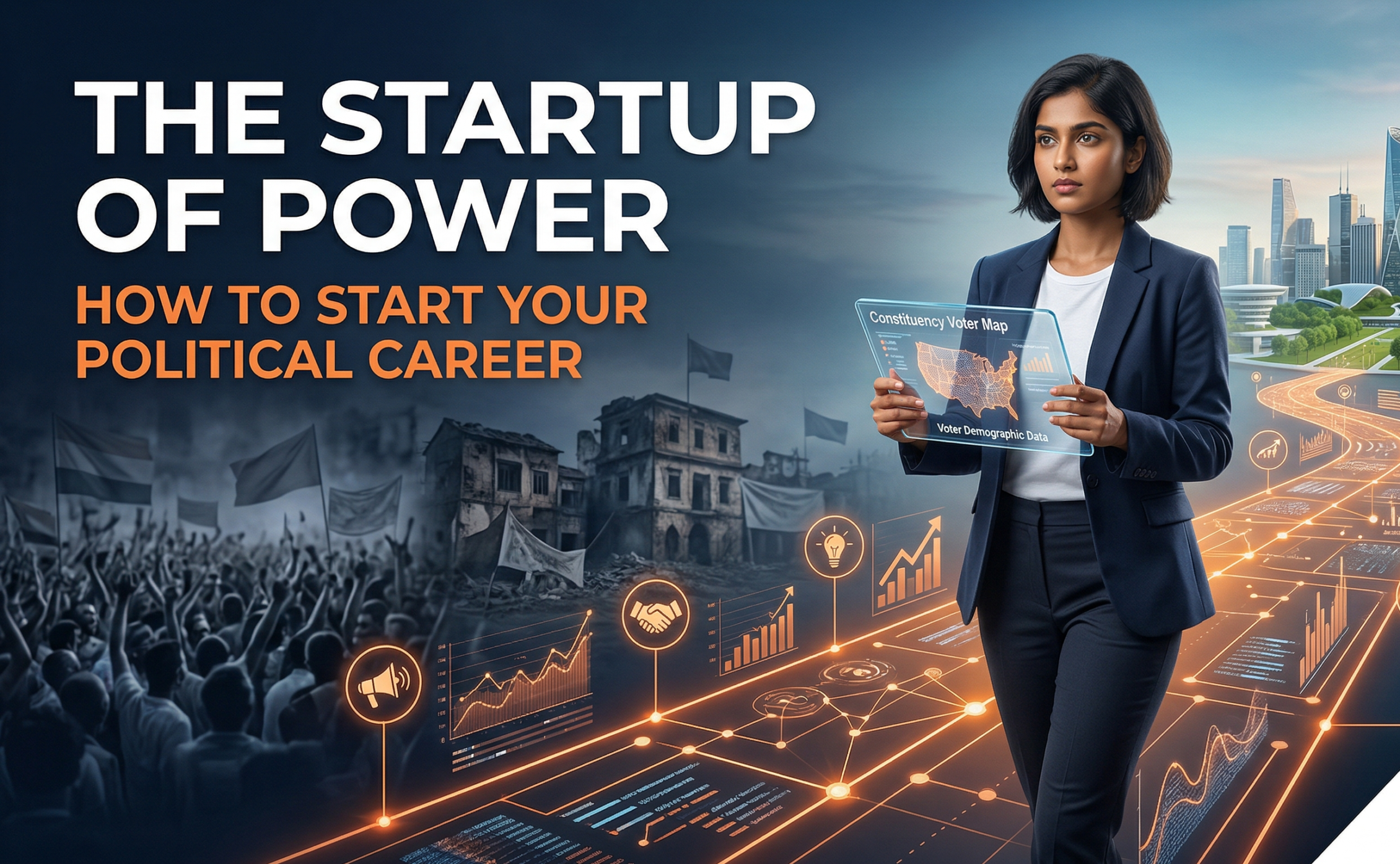
The Startup of Power: How to Start a Political Career in the Neo-Political Era
Moving beyond inheritance and opportunism. A data-driven guide for the next generation of Indian leadership.
What History Tells Us: The Evolution of Power
In the classical era of Chanakya or Machiavelli, politics was a game of fortification and alliances. Post-independence Indian politics was defined by the “Grassroots Struggle”—leaders were born in jails during protests or rose from the student unions of the 70s. Power was inherited through lineage or earned through decades of loyalty to a party machinery.
History teaches us that power is never given; it is captured during moments of vacuum. The great leaders of the past didn’t wait for a “ticket”; they created a situation where the party had no choice but to recognize them. However, the old tools—muscle power and pure caste arithmetic—are hitting a ceiling. The history of the 21st century will record the shift from “Bahubali” (Strongman) politics to “Budhibali” (Strategist) politics.
The Need for Contemporary Politics
Why is the old guard failing? Because contemporary voters are suffering from Information Overload. Traditional politics relied on the “Monologue”—a leader speaking on a loudspeaker. Contemporary politics requires a “Dialogue.”
Today’s voter is transactional. They don’t want to hear about 1947; they want to know about their 2026 EMI, their local drainage, and their digital privacy. There is a desperate need for politicians who can speak the language of Governance (Sushasan) rather than just Identity. The modern politician is no longer just a leader; they are a Service Provider for their constituency.
Future of Politics: The Disruptor Blueprint (Balen Shah)
The rise of Balen Shah in Kathmandu is the ultimate case study for GenZ politics. He didn’t come from a political family. He was an engineer and a rapper. His victory signifies the death of “Traditional Campaigning.”
The Balen Shah Formula:
- Professional Authority: Being an engineer gave him the “Fixer” image.
- Digital Native: He used social media not as an ad platform, but as a direct communication line.
- Apolitical Branding: He focused on “Work over Words,” capturing the youth vote that is tired of Left vs. Right debates.
The future belongs to the “Civilian Candidate”—someone who looks like the voter, speaks like the voter, but thinks like a CEO. In Bihar and across India, the GenZ voter (born after 2000) cares about Impact over Ideology.
The Death of the Spectrum & The Rise of Neo-Politics
Traditional politics based on the Political Spectrum (Left, Right, Center) is dying. Why? Because of Extreme Opportunism. When voters see parties of opposite ideologies forming coalitions for power, they stop believing in the “Spectrum.” Ideology has become a mask for convenience.
Enter: Neo-Politics
Neo-Politics is driven by Hype, Stunts, and Rapid Impact. It targets the “Vulnerable Voter”—the youth without jobs, the women concerned about safety, and the small business owner. It uses high-impact stunts (visual politics) to create a sense of action. While traditional politics is a marathon of 5 years, Neo-Politics is a series of Sprints (Viral Moments) that keep the leader relevant every single day.
The Roadmap: How to Start Your Political Career
If you want to enter politics in 2026, forget the old “Youth Wing” route. Start your career as a Political Startup.
1. Demographic Mapping
Don’t just “visit” a constituency. Map it. Know exactly how many first-time voters, how many retired government employees, and how many female-led households exist. Data is your only loyalty.
2. Demand-Based Politics
Treat your entry like a product launch. What is the “Pain Point” of your area? Is it water? Is it the lack of a digital library? Solve one specific problem using your own resources before asking for a vote.
3. The Neo-Trend Factor
Embrace “Visual Governance.” When you do work, it must be documented with high-fidelity production. If the people don’t see it on their phones, it didn’t happen.
4. Day-One Team Building
A leader is only as good as their War Room. You need four people immediately: A Data Analyst, a Content Creator (Video/Reels), a Legal Advisor, and a Local Mobilizer. Do not build a team of “Yes-men”; build a team of Experts.
Role of Social Media & Political Consultancy
In 2026, your “Digital Image” is your primary identity. A voter will check your Instagram profile before they listen to your speech. Social media is no longer about posting photos with garlands; it’s about Sentiment Manipulation and Narrative Building.
This is where Political Consultancy becomes mandatory. You cannot be the player and the coach at the same time. You focus on the people; the consultants focus on the Perception.
Ready to Deploy Your Campaign?
At PoliticoInsights, we don’t just manage accounts; we build Political Brands. From constituency deep-dives to AI-driven voter targeting, we provide the intelligence you need to capture the seat.
CONNECT WITH THE WAR ROOM →