

The Rise, Fall & Unfinished Revolution
of Indian Communism
From the mill districts of Bombay to the paddy fields of Kerala — over a century, India’s communist movement has shaped trade unions, governments, and the national conscience. Can it survive the 21st century?
“The history of all hitherto existing society is the history of class struggles.” — But in India, class struggle has always competed with caste, religion, region, and identity.
India is not a country where ideology travels in straight lines. Its communists have led governments for three uninterrupted decades in West Bengal, sparked an armed peasant uprising in Naxalbari that echoes to this day, and produced some of the finest constitutional minds the country has seen. They have also been called anti-national, been jailed under colonial law, and watched their electoral strength dwindle from a dominant force to a rump. The story of communism in India is, in many ways, the story of India’s own unresolved contradictions.
And yet — it refuses to end.
How It All Began: The 1920s and the Making of a Movement
The year was 1920. The Russian Revolution was three years old, the world was rearranging itself, and a group of Indian intellectuals — inspired, electrified — formally established the Communist Party of India in Tashkent. M.N. Roy, a Bengali revolutionary who had rubbed shoulders with Lenin himself, is credited as a founding figure. Back home, S.A. Dange was writing pamphlets. P.C. Joshi would later build the party’s mass base.
The early communists were not only Marxists — they were deeply embedded in the anti-colonial struggle. They organized mill workers in Bombay and Kanpur, they agitated in the railways, and they built the All India Trade Union Congress (AITUC). The British colonial administration, recognizing the threat, put them on trial in the historic Peshawar Conspiracy Case of 1922 and the Meerut Conspiracy Case of 1929 — which, ironically, gave the communists national publicity and turned the defendants into working-class heroes.
A Century in Milestones
M.N. Roy and associates form the Communist Party of India, inspired by the Bolshevik Revolution and international socialist solidarity.
33 labour leaders arrested; the trial drags on for years but gives the communist movement national attention and moral credibility.
E.M.S. Namboodiripad leads CPI to a historic electoral win in Kerala — the first democratically elected communist government anywhere in the world.
Ideological differences over Moscow vs Beijing, and the Sino-Indian War, tear the party apart. CPI(M) breaks away, adopting a more radical stance.
Peasants in West Bengal’s Naxalbari village rise up in armed revolt. The “Naxalite” movement fractures into dozens of radical groups, many still active today in central India.
Jyoti Basu leads the Left Front to power in West Bengal — beginning what would become 34 years of uninterrupted left rule. Land reform under Operation Barga reshapes rural Bengal.
The United Front offers Basu the PM post. CPI(M)’s politburo declines — Basu himself calls it a “historic blunder.” A missed moment that haunts the Left still.
Mamata Banerjee’s Trinamool Congress sweeps West Bengal. After 34 years, the Left Front’s rule ends — a devastating symbolic and organizational blow.
BJP defeats the Left in Tripura, ending 25 years of Communist governance. Only Kerala remains as a Left-governed state.
In a historically unprecedented result, the Left Democratic Front wins Kerala’s assembly elections for a second consecutive term — the first time any government in Kerala repeated since 1980.
Faced with shifting economic structures, Left-affiliated unions begin aggressively forming localized blocks for platform, delivery, and gig workers, testing a new blueprint for urban mobilization.
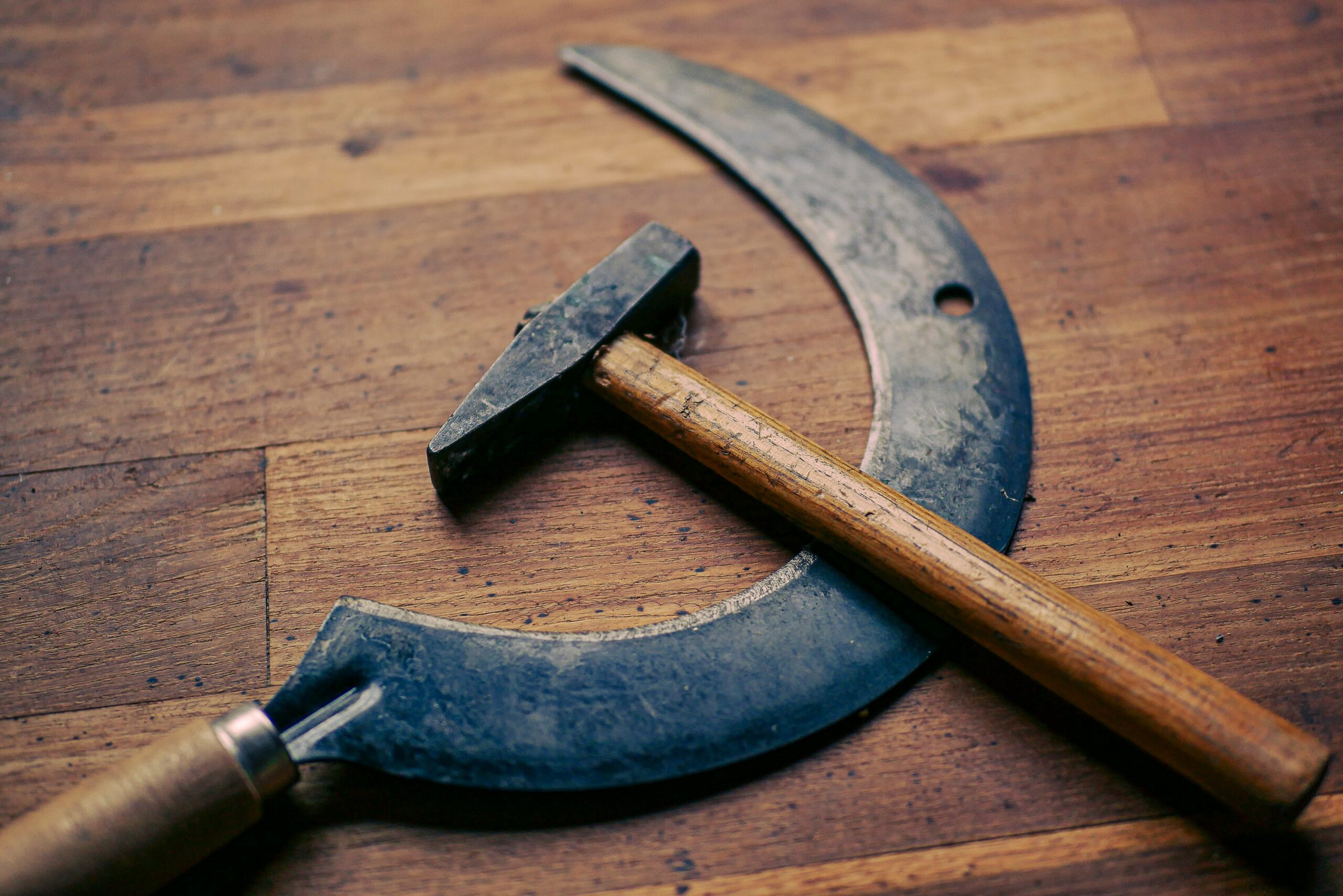
Laal Salam: More Than a Slogan
To outsiders, “Laal Salam” — Red Salute — might sound like a relic. A clenched fist raised at rallies that are slowly thinning out. But to anyone who has witnessed a trade union march in Thiruvananthapuram, or a student demonstration at JNU, or a sharecroppers’ meeting in rural Odisha, the words carry something heavier than nostalgia.
The red salute has its roots in the internationalist workers’ movements of the 19th century. In India, it became the unifying call across linguistic, caste, and regional lines — a declaration that, whatever your tongue or your village, your oppression had the same structural source: capital over labour. It was a refusal to be invisible.
In India, class struggle has always had to negotiate with caste — that is the defining tragedy, and defining challenge, of the Indian left.— Politico inisghts, Centre for Policy Research
What made the slogan powerful was not the word “red” but the community it created. In the 1940s, communist cultural fronts — the Indian People’s Theatre Association (IPTA) — produced plays, songs, and poetry that carried left ideas to millions who couldn’t read party manifestos. Legendary figures like Balraj Sahni, Faiz Ahmed Faiz (who had deep ties with Indian leftists), and Salil Chowdhury gave the movement cultural weight. The Left understood, perhaps before anyone else in Indian politics, that you don’t win mass support through argument alone — you win it through art.
The Kerala Model: What Governance Looks Like
The single most credible argument the Indian Left can make today is Kerala. The state consistently ranks first or near-first in India on literacy, life expectancy, gender equality, infant mortality, and human development indicators — and it has done so across decades of Left and Congress rule, with the Left having set the structural foundations.
(National avg: 77%)
(National avg: 70)
Left Rule — W. Bengal
Communist Government
CPI(M) Alone
Kerala’s communist governments pioneered land reform that redistributed over 1.2 million acres from landlords to tillers. They invested in public health infrastructure long before it became fashionable. The “Kerala Model” became a case study in development economics worldwide — proof that social outcomes don’t require high per-capita income, but rather political will and redistributive policy.
The LDF’s consecutive 2021 victory was particularly significant. The government under Chief Minister Pinarayi Vijayan had managed the COVID-19 pandemic with unusual competence, leaning on a robust public health system. The electorate rewarded it. It was a rare moment of validation in an otherwise difficult decade for the Indian Left.
The Leaders Who Built the Movement
- M.N. Roy (1887–1954) — Co-founder of CPI; debated Lenin directly at the Second Comintern Congress. Later broke with orthodox Marxism to develop “Radical Humanism.”
- E.M.S. Namboodiripad (1909–1998) — Architect of Kerala’s communist governance; led the world’s first elected communist government in 1957. A theorist and organiser in equal measure.
- Jyoti Basu (1914–2010) — West Bengal’s longest-serving CM (1977–2000); a pragmatic Marxist who embraced foreign investment while maintaining cadre discipline. Turned down the PM’s chair.
- Harkishan Singh Surjeet (1916–2008) — The master coalition-builder; instrumental in keeping the United Progressive Alliance together from outside.
- Charu Majumdar (1918–1972) — Founder of CPI(ML) and ideological father of Naxalism; believed parliamentary democracy was a trap. Died in police custody.
- Sitaram Yechury (1952–2024) — Modern CPI(M) general secretary; sought to modernise the party’s appeal while maintaining ideological core. Following his passing in 2024, the party entered a crucial transitional phase ahead of the 2025 Party Congress to realign national strategy.
The Decline: What Went Wrong?
The collapse of the Left in West Bengal is perhaps the most studied political implosion in modern Indian history. After 34 years of governance, the CPI(M) had become what it once opposed: an entrenched power structure. Cadre violence was documented. Land acquisition in Singur and Nandigram — ironically, to attract industry — created a moral crisis that Mamata Banerjee exploited masterfully. The party that had once stood for the peasant had, in the eyes of many peasants, become the establishment.
The intellectual Left also began to fracture. The urban middle class — once sympathetic — drifted toward issue-based civil society activism. The rise of identity politics, particularly around caste movements led by non-Left forces, complicated the Left’s claim to speak for the oppressed. A Dalit worker in Bihar or a tribal farmer in Jharkhand had new political options — and many took them.

Five Hurdles That Define the Crisis
The problems are structural, not merely electoral. Understanding them is essential to any honest assessment of the Left’s future.
India’s expanding middle class doesn’t see itself as “working class.” Young Indians want startups, not state enterprise. Class politics must speak to aspiration, not just grievance.
Caste and religious identity regularly trump economic class in electoral politics. The Left has never adequately resolved how to integrate Ambedkarite politics into Marxist frameworks.
Cadre structures built for the 20th century struggle with digital-age organising. Internal democracy and ideological updating have often lagged behind political realities.
Opponents have successfully framed the Left’s internationalism and secularism as hostility toward Indian culture. This perception gap is more damaging than any policy disagreement.
Gig workers, platform labour, contract employees — the new precariat is large and exploited. Yet traditional union structures weren’t built to organise them. This is the Left’s biggest unexploited opening.
The English-speaking liberal class that once provided intellectual support has largely moved to NGOs, journalism, and civil society — operating outside party structures entirely.
Campuses as the Last Citadel
Walk into the Jawaharlal Nehru University campus in Delhi on any given day and you will see what electoral politics cannot fully capture. There are posters arguing about Palestine, pamphlets on caste discrimination, seminars on Ambedkar and Marx. Student political cultures at JNU, Delhi University, and Hyderabad Central University remain among the most vibrant left spaces in the country — and they matter precisely because they are spaces of formation.
The SFI (Students Federation of India, affiliated to CPI(M)) and AISF regularly produce cadres who go on to build labour movements, run local governance, and write the academic texts that shape the next generation’s politics. The 2016 controversy at JNU — when students were accused of sedition for anti-nationalist sloganeering — paradoxically galvanised a new generation of left-leaning youth who saw in the state’s overreach exactly the authoritarianism their politics had warned about.
The Left’s future may be written not in legislatures, but in the organizing drives of Zomato delivery workers and ASHA health volunteers.— Economic and Political Weekly, 2023
There is something significant in where the Left still wins: not in legislatures so much as in the invisible labour that holds society together. CITU (Centre of Indian Trade Unions) organises millions of workers. Left-affiliated farmers’ unions were at the forefront of the historic 2020–2021 farm laws protest — one of the largest sustained protest movements in human history — even if the political credit went elsewhere.
The Path Forward: Six Directions for Revival
If there is to be a genuine renewal, it cannot come from nostalgia. These are the directions that genuinely matter.
-
Organise the New Precariat Zomato riders, gig workers, contractual nurses, ASHA workers, domestic workers — this is India’s new working class. It is vast, exploited, and largely unorganised. The Left that wins this constituency will matter again.
-
Build an Ambedkar-Marx Synthesis The most intellectually honest challenge before the Indian Left is to genuinely integrate caste analysis into class politics — not as a footnote, but as a co-equal framework. Leaders like B.T. Ranadive attempted this; the project remains unfinished.
-
Go Digital Without Losing Depth The Left has content — decades of intellectual tradition, policy analysis, and grassroots stories. It lacks the delivery infrastructure. A serious digital organising effort could change this without abandoning ideological substance.
-
Reframe Nationalism Economic patriotism — the argument that a nation that allows its citizens to go hungry or unemployed is failing its people — can be a powerful left-nationalist frame. Constitutional values are worth fighting for as patriotic acts.
-
Build Strategic Alliances Opposition unity, where ideologically coherent, can give the Left electoral relevance beyond its diminished base. But alliance-building must not mean ideological dissolution — the Left’s value in coalition is as a principled anchor.
-
Champion Environment and Climate Justice The global Left’s growing engagement with ecological politics is finding echoes in India — Adivasi land rights, anti-mining struggles, climate vulnerability of the poor. This is natural Left territory if claimed boldly.
Crossroads, Not Epitaph
The obituaries for Indian communism have been written before. After the collapse of the Soviet Union in 1991, commentators declared the Left irrelevant. It went on to win elections in three states and support a national government for five years. History rarely ends when we expect it to.
The conditions that gave rise to communist politics in India — inequality, landlessness, labour exploitation, caste oppression, and elite capture of democracy — have not gone away. If anything, the concentration of wealth at the top, the casualisation of labour, and the pressures on the rural poor have intensified in ways that classical Marxist analysis maps with uncomfortable accuracy.
The question before the Indian Left is not one of relevance. Relevance is not the issue — the issues are strategy, organisation, and the willingness to evolve without betraying the core commitment to the many over the few.
Whether that evolution comes in time is what history will judge. But the working class — platform workers, farmers, contract teachers, daily wagers — are still waiting for a political home that sees them clearly.
Laal Salam.