
The Arithmetic of the Heartland Rewritten
A comprehensive deep-dive into Uttar Pradesh’s seismic electoral transformation — from rigid caste fiefdoms to a high-tech pro-incumbency machine, the labharthi revolution, the PDA counter-strategy, and the resurgent Social Justice coalition that shook the Hindi heartland in 2024.
For decades, the political logic of India has been governed by a singular, unyielding proverb: “the route to Delhi goes through Lucknow.” As the nation’s indispensable heartland, Uttar Pradesh has long been the ultimate litmus test for any party with national ambitions — sending 80 Members of Parliament to the Lok Sabha, representing a demographic behemoth capable of single-handedly making or breaking a central government. No other state commands this outsized leverage over the Republic’s fate.
Yet the state is now shedding its old skin — and doing so with seismic force. The historical arithmetic of the heartland, once characterized entirely by rigid caste hierarchies, local fiefdoms, and the predictable dominance of regional satraps, has been fundamentally rewritten across two turbulent election cycles. In its place emerged a highly centralized, data-driven, high-tech “pro-incumbency” machinery constructed by the Bharatiya Janata Party. But as the 2024 General Election demonstrated with devastating clarity, even this formidable machine is not immune to the fierce, grassroots resurgence of Social Justice coalitions and deep-seated economic anxieties that cut across caste lines.
This analysis synthesizes comprehensive field data, post-poll surveys by CSDS-Lokniti, and electoral statistics from the Election Commission of India to decode the most surprising ideological pivots in a state where roughly 77% of the population still resides in rural villages — communities navigating the complex, often contradictory intersection of traditional culture, caste identity, welfare dependence, and an urgent hunger for economic dignity.
UP’s 80 Lok Sabha seats constitute roughly 14.7% of the entire 543-seat Parliament. Historically, no party has formed a majority government at the Centre without a dominant performance in UP. The state’s electorate of over 15 crore registered voters is larger than the entire population of Germany. Its political shifts resonate directly through neighboring North Indian states — Bihar, Madhya Pradesh, Rajasthan, Uttarakhand, Haryana — making it the true bellwether of Hindi belt politics.
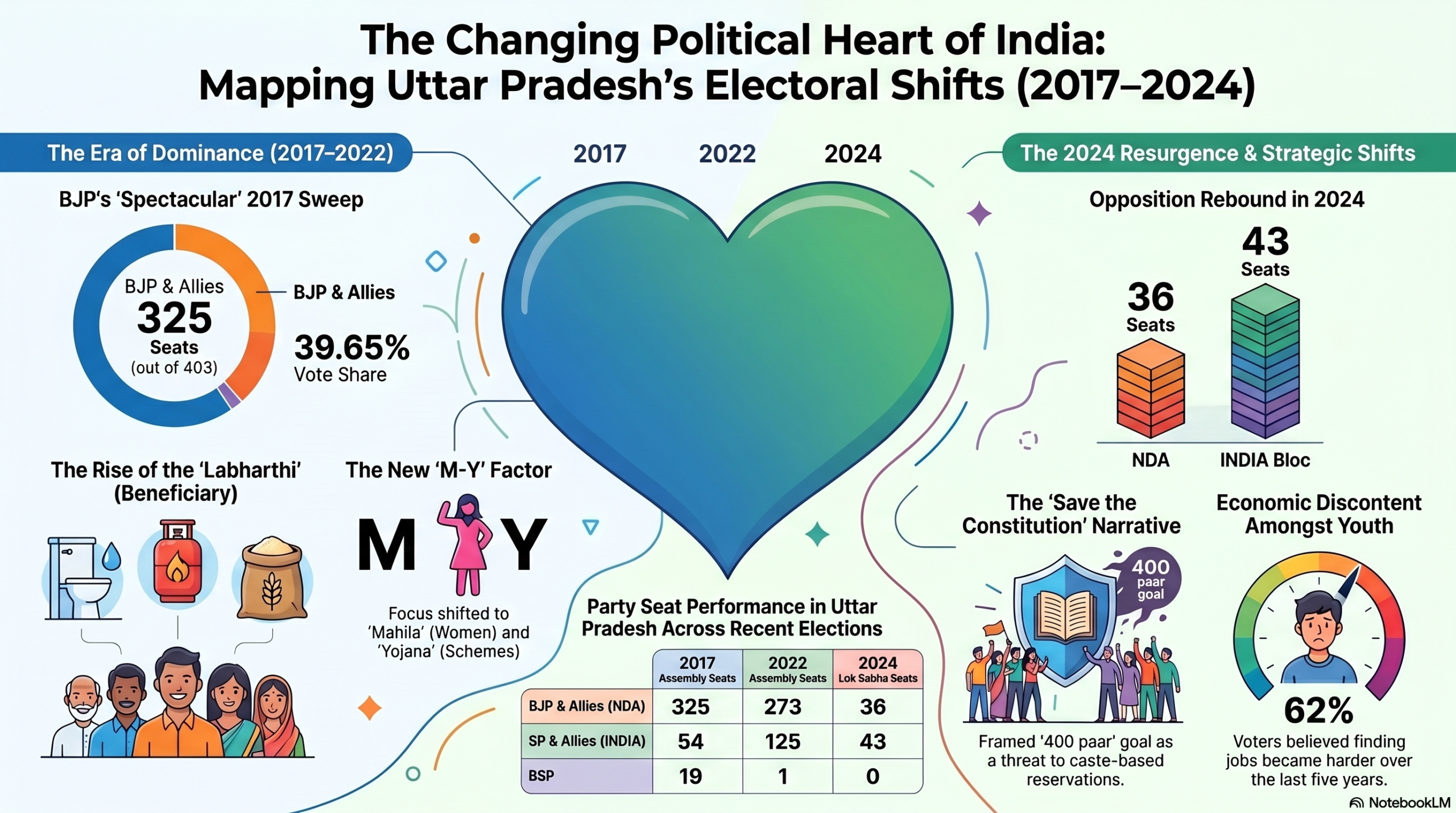
The New “M-Y” Factor: From Identity to the Messenger-in-Chief
The most profound structural transformation in Uttar Pradesh’s electoral landscape is the systematic pivot from traditional identity politics to a strategic, highly branded form of welfare statism. Historically, the acronym “M-Y” stood exclusively for the Muslim-Yadav alliance — the formidable demographic bloc that anchored the Samajwadi Party and allowed it to dominate state politics through the 1990s and 2000s, an era defined by Mulayam Singh Yadav’s iron grip on the Gangetic plains.
Today, that acronym has been systematically co-opted, redefined, and weaponized by the BJP’s political strategists. The new “M-Y” driving modern heartland arithmetic is Mahila (Women) and Yojana (Schemes) — a deliberate rebranding that seeks to transcend caste arithmetic entirely and replace it with a direct, transactional bond between state and individual citizen.
The Labharthi Architecture
The ruling administration has cultivated a massive, cross-caste base of labharthis (beneficiaries) receiving direct, tangible assets from the state. The welfare delivery ecosystem includes: constructed toilets under the Swachh Bharat Abhiyan, LPG gas cylinders via the Pradhan Mantri Ujjwala Yojana (targeting rural women specifically), subsidized housing through PM Awas Yojana (Gramin), free monthly food rations under PM Garib Kalyan Anna Yojana, and direct cash transfers under PM Kisan Samman Nidhi. In UP alone, over 1.5 crore households received Ujjwala connections, and over 18 lakh housing units were sanctioned under PMAY-G.
This distribution network is not merely routine governance. It has been elevated into the meticulous construction of a political identity — a gratitude economy. The seamless delivery of these conveniences creates a direct emotional conduit between the individual household, particularly the woman of the household, and the Prime Minister personally, often insulating central leadership from localized anti-incumbency against sitting MLAs or MPs perceived as ineffective or corrupt.
“The remarkably high percentage of women votes the BJP has received suggests that ‘mahila’ and ‘yojana’ are a new M-Y factor that has uprooted the original Muslim-Yadav community-caste arithmetic.”
— Rajdeep Sardesai, Senior Journalist and Author
The Moditva Phenomenon
This distinct “Moditva” constituency is sustained by a “messenger-in-chief” whom voters increasingly view not through a conventional political lens but through an almost ascetic, devotional one. Sociological ground studies reveal a staggering psychological layer: some marginalized voters in eastern UP and the Bundelkhand region reported remaining fiercely loyal to the Prime Minister even following severe personal tragedies — including losing spouses during the catastrophic COVID-19 second wave when oxygen shortages claimed tens of thousands of lives in UP alone. This loyalty, striking in its resilience, is rooted in a near-faith conviction encapsulated in the now-iconic slogan “Modi hai to mumkin hai” (With Modi, it is possible) — a phrase that has effectively become a social coping mechanism for aspirational poverty.
While labharthi politics have proven extraordinarily effective at building a loyal cross-caste base, analysts note this model faces a structural ceiling. Beneficiary fatigue — where voters begin to take schemes for granted and demand more substantive economic transformation — is already visible in urban and semi-urban constituencies. The 2024 results showed that in constituencies with higher literacy and urbanisation, welfare loyalty was weakest, and issues of unemployment, inflation, and institutional trust dominated voter decisions.
The “400 Paar” Paradox: When a Slogan Triggers an Alarm
If the 2022 UP Assembly election was a testament to BJP’s seemingly unassailable grip on the heartland, the 2024 General Election delivered a historic, sobering reality check that reverberated from Meerut to Mirzapur. The ambitious “Ab ki baar, 400 paar” (This time, crossing 400 seats) national campaign — meticulously designed to project an aura of total, pre-ordained dominance — unintentionally activated a political alarm system among the most vulnerable sections of the electorate.
The Constitutional Narrative Coup
The INDIA alliance, with unusual strategic agility, capitalised on specific on-record provocations from senior BJP leaders. Karnataka MP Anantkumar Hegde publicly suggested a two-thirds majority was necessary to “set right distortions” in the Constitution, while candidate Jyoti Mirdha spoke of “constitutional amendments” in the national interest. The opposition deployed these statements with surgical precision across thousands of rally speeches, WhatsApp groups, and regional news channels in Hindi, Bhojpuri, and Awadhi.
They successfully reframed the entire 400-seat narrative: not as ambition for development, but as a direct existential threat to the Constitution authored by Dr. B.R. Ambedkar — and, by direct extension, to the affirmative action reservation system that has underpinned social mobility for seven decades. The message delivered in the idiom of the village was devastatingly simple: “Hazaar seat aaye to reservation khatam” (If they get a thousand seats, reservation will end).
(vs 49.6% in 2019)
(vs 62 in 2019)
in UP (2024)
The symbolic masterstroke was Rahul Gandhi and Akhilesh Yadav physically holding aloft a red-bound copy of the Constitution at dozens of rallies across UP — from Varanasi to Azamgarh. The red book became the single most recognisable campaign prop of the 2024 cycle in the Hindi belt, communicating instantly across literacy barriers a message of constitutional vigilance that resonated viscerally with Dalit and OBC communities across Uttar Pradesh, Bihar, and Madhya Pradesh alike.
The Silent Surge and the Irony of Representation
The “Mahila” dimension of the new M-Y factor presents one of the most layered and contradictory stories in contemporary Indian politics. Women have simultaneously moved to the vanguard of the democratic process as voters and remained systematically excluded from it as policymakers and holders of real power.
Record Turnout, Minimal Representation
In the 2022 UP Assembly elections, female voter turnout reached a historic 62.24% — significantly surpassing male turnout at 59.56%. This was not an isolated phenomenon but a continuation of a broader trend across North India, with women voters in Bihar, Rajasthan, and Madhya Pradesh similarly showing turnout rates exceeding male participation in recent cycles. Yet the representational chasm is stark and deeply troubling.
Despite wielding decisive electoral power, women are largely absent from the rooms where decisions are made. The glass ceiling operates not merely in the social sphere but is structurally embedded in the internal ticket-distribution processes of every major political party, including those that loudly deploy the “Mahila” rhetoric in their campaign messaging.
“The irony is that the Women’s Reservation Bill, which seeks to increase one-third representation of women in Parliament and State Assemblies, has been pending since 1998. This remains a bitter example of an unjust decision in a male-dominated society.”
— Dr. Monika Srivastava & KM Shweta Chaudhary, Researchers
The Portfolio Ceiling
When women do manage to navigate the hostile landscape of candidature selection and win, they face a second ceiling: portfolio discrimination at the cabinet level. Female ministers are systematically relegated to “soft” ministries — Women and Child Welfare, Culture, Social Justice — while being comprehensively excluded from “hard” ministries wielding significant financial or executive power: Finance, Home Affairs, Urban Development, Public Works. This pattern holds consistently across BJP, SP, BSP, and Congress governments in the Hindi belt, revealing a bipartisan structural bias that transcends electoral rhetoric.
The Myth of the Thakur Revolt and the PDA Strategy
In the charged months preceding the 2024 General Election, the political corridors of Delhi and Lucknow buzzed with breathless speculation about an imminent “Thakur revolt” against the BJP. Pre-poll media coverage heavily amplified localized Rajput community protests in western UP — particularly around Muzaffarnagar, Shamli, and Bulandshahr — suggesting a severe, potentially decisive crack in the incumbent party’s upper-caste fortress.
Post-election analytics from CSDS-Lokniti conclusively dismantled the revolt narrative. The real story of the BJP’s collapse was written not by Rajput disaffection, but by the surgical realignment of OBC and Dalit communities.
| Caste Group | BJP Support 2019 | BJP Support 2024 | Change |
|---|---|---|---|
| Thakur / Rajput | 82% | 89% | ↑ +7% (revolt myth busted) |
| Brahmin | ~79% | ~76% | ↓ −3% (marginal slip) |
| Non-Yadav OBC (Kurmi, Koeri) | ~65% | ~52% | ↓ −13% (decisive erosion) |
| Jatav Dalit | ~18% | ~24% | ↑ +6% (from BSP, split vote) |
| Muslim | ~8% | ~7% | Stable (consolidated to SP/Cong) |
The PDA Blueprint Decoded
The genuine erosion of the BJP’s vote share stemmed from a brilliant, meticulously engineered counter-strategy championed by SP Chief Akhilesh Yadav: the PDA strategy, standing for Pichada (Backward Classes), Dalit, and Alpsankhyak (Minorities). By aggressively prioritizing ticket distribution to non-Yadav OBCs and Dalits — communities long excluded from SP’s inner circle — Yadav fundamentally re-engineered the state’s caste calculus, signaling they were now the party’s political center of gravity.
- The Jatav Exodus from BSP: Jatav Dalits — traditionally the immovable core of Mayawati’s BSP — deserted the party in substantial numbers due to perceptions that BSP had effectively become the “B-team” of the BJP, drawing away opposition votes without genuinely contesting the ruling party. Approximately 24% migrated toward BJP (primarily due to welfare schemes), while roughly 25% consolidated behind the INDIA bloc, motivated by the constitutional protection narrative.
- The Non-Yadav OBC Drift: Support from non-Yadav OBCs — the Kurmis, Koeris, Prajapatis, Nishads, and Mauryas — slid meaningfully toward the SP-led opposition. This was the most devastating blow to the BJP’s coalition. Since 2014, the meticulous inclusion of non-Yadav OBCs — approximately 25–27% of UP’s population — had been the indispensable bedrock of BJP dominance in the heartland. Their drift, even partial, was sufficient to flip dozens of constituencies.
- The Muslim Re-consolidation: Muslim voters — approximately 19% of UP’s population — demonstrated remarkable tactical unity in 2024, consolidating almost entirely behind the SP-Congress alliance. This strategic coherence, combined with the PDA realignment, produced a formidable opposition arithmetic in over 40 constituencies across the state.
“The PDA strategy was not merely a caste coalition — it was a message of political inclusion sent to communities that the establishment had systematically sidelined for a generation.”
Congress: From 388 Seats to 2 — and a Fragile Resurgence
The trajectory of the Indian National Congress in Uttar Pradesh constitutes one of the most staggering cases of political collapse in any democracy’s recent history. The party that once dominated the state as an unstoppable post-independence behemoth — holding a staggering 388 seats in the 1951 Assembly elections, when UP politics was synonymous with Congress — reached its absolute nadir in 2022 by winning just 2 seats out of 403.
The Anatomy of Collapse
The decay unfolded across multiple dimensions simultaneously. Congress lost its upper-caste base to the BJP post the 1992 Ayodhya movement. It lost its Dalit base to BSP post Kanshi Ram’s social mobilisation. It lost its OBC base to the SP’s Mandal politics. And critically, it failed to build any substantive organizational infrastructure in UP’s 75 districts through three decades of near-continuous decline — leaving it without the village-level presence that is non-negotiable for competitive politics in rural north India.
The 2022 campaign under Priyanka Gandhi Vadra — branded under the “Ladki Hoon, Lad Sakti Hoon” slogan — was resource-intensive and media-visible, yet yielded a vote share of an abysmal 2.33% and a win ratio of just 0.5%. The scale of failure created deep despair within the organizational cadre, with many senior leaders quietly joining the BJP or SP.
1951: 388 seats → 1967: 198 seats → 1980: 309 seats → 1989: 94 seats → 2002: 25 seats → 2017: 7 seats → 2022: 2 seats. The free-fall spans seven decades and represents the complete erosion of every major constituency the party once claimed as its own in the Hindi heartland.
The 2024 Recovery: Real or Mirage?
By strategically subordinating itself within the INDIA alliance — contesting just 17 Lok Sabha seats versus SP’s 63 — and concentrating resources on historically sympathetic constituencies, Congress secured 6 Lok Sabha seats in 2024. The reclamation of Amethi and Raebareli — the Gandhi family’s traditional heartlands — with substantial margins was particularly significant, both symbolically and organizationally. Rahul Gandhi’s victory in Raebareli by over 3.9 lakh votes provided a credible platform from which to rebuild the party’s Hindi heartland narrative heading into the 2027 Assembly elections.
Youth Disillusionment: A Ticking Time Bomb Across North India
Beneath the macro-level analysis of caste arithmetic and welfare schemes lies a deeply volatile factor with the potential to fundamentally destabilize the current political paradigm — not just in UP, but across the entire Hindi belt: the systematic radicalization of youth disillusionment. Young voters aged 18–35 constitute roughly 40% of the electorate in North Indian states. Their mood is darkening considerably.
The youth vote was the undisputed engine of the “Modi Wave” in 2014, featuring a record 68% turnout among 18–25 year olds who enthusiastically embraced the promise of “Achhe Din” (Good Days). A decade later, many of those same voters — now in their late 20s and early 30s, armed with degrees from colleges in Lucknow, Kanpur, Allahabad, and Gorakhpur — are confronting a labour market of devastating inadequacy.
The Structural Unemployment Crisis
Uttar Pradesh’s youth unemployment rate consistently tracks above the national average. The state produces millions of graduates annually — from engineering colleges, polytechnics, and arts faculties — into an economy that cannot absorb them at the scale or remuneration they were promised. Government employment, which remains the aspirational gold standard across North India’s social hierarchy, is simultaneously the site of repeated institutional failure, systemic corruption, and administrative collapse.
The sheer scale of the unemployment crisis was laid bare in a single data point: approximately 48 lakh candidates appeared to compete for just 60,244 constable positions — a competition ratio of roughly 80:1 for one of the lowest-tier government jobs. The examination was conducted across 2,385 centers statewide. Following credible evidence of a systematic question paper leak circulating on social media, the state government was compelled to cancel the entire examination. A subsequent crackdown on the paper leak network resulted in 287 arrests. The millions of aspirants who had spent months preparing — many investing their family’s life savings in coaching institutes — were left with nothing and no timeline for rescheduling.
This was not an isolated incident. Similar paper leaks had compromised the UP Teacher Eligibility Test (UPTET), the UP Sub-Inspector examination, and multiple other state recruitment examinations in preceding years, creating a pervasive climate of institutional distrust that no digital PR campaign can easily overcome.
The Coaching Center Economy’s Political Consciousness
The social geography of youth aspiration in North India concentrates in a handful of cities. Prayagraj’s Mukherjee Nagar area, Lucknow’s Hazratganj coaching belt, Kanpur’s examination preparation zones, and similar clusters in Patna (Bihar) and Jaipur (Rajasthan) house hundreds of thousands of aspirants living in cramped rented rooms on subsistence budgets — preparing for government examinations for years at a stretch. This is an economically precarious, politically engaged, and deeply resentful demographic. They consume political news voraciously, follow opposition figures on social media, and increasingly view the government’s “Rojgar Mission” not as a promise but as a cruel institutional joke.
The youth unemployment crisis is not unique to UP. Similar structural failures in government recruitment — paper leaks, delayed exam results, extended vacancy freezes — have been documented in Bihar (BPSC controversies), Rajasthan (REET paper leak 2021), Madhya Pradesh (MPPSC delays), and Haryana (HSSC Group D cancellations). This cross-state pattern suggests a systemic administrative failure that could serve as a powerful unifying grievance for the INDIA alliance across the Hindi belt in the 2027 Assembly cycles.
UP as North India’s Bellwether: Bihar, MP, Rajasthan in Context
The electoral shifts in Uttar Pradesh do not occur in isolation. They send visible tremors through every neighboring North Indian state — Bihar, Madhya Pradesh, Rajasthan, Uttarakhand, Haryana, and Jharkhand — sharing overlapping caste demographics, similar welfare delivery frameworks, and comparable youth employment crises. Understanding UP is, in many ways, understanding the entire Hindi belt’s political direction.
Bihar: The PDA Echo and the Nitish Factor
Bihar’s 2024 political dynamics showed clear echoes of UP’s PDA strategy. The RJD-Congress alliance under Tejashwi Yadav attempted a similar backward-Dalit-Minority consolidation, though with less decisive success due to Nitish Kumar’s return to the NDA and his credibility among Extremely Backward Classes (EBCs), who constitute nearly 36% of Bihar’s electorate. Still, the Mahagathbandhan secured 9 seats against NDA’s 30 — a significantly better performance than 2019 and a proof-of-concept that PDA-style mathematics works when the opposition can present a credible face.
Madhya Pradesh: The Ladli Behna Template
In Madhya Pradesh, the BJP’s decisive Assembly election victory in November 2023 demonstrated that the labharthi model retains extraordinary potency when combined with strong state-level leadership. The Ladli Behna Yojana — a direct monthly cash transfer of Rs 1,000 (later raised to Rs 1,250) targeting women — is widely credited with neutralising anti-incumbency in the Shivraj Singh Chouhan government and producing an unexpected BJP majority. This is the UP welfare model, replicated with state-specific customisation. Its success has confirmed the template for BJP state governments across the Hindi belt heading into 2025–27 election cycles.
Rajasthan: The Anti-Incumbency Override
Rajasthan showed that welfare schemes alone cannot override structural anti-incumbency when governance fatigue is overwhelming: the Congress government fell despite its ambitious Chiranjeevi Health Insurance scheme and Indira Gandhi Smartphone Yojana. The lesson from the North Indian aggregate data is nuanced — welfare schemes are necessary but not sufficient; they must be reinforced by the perception of economic progress, administrative credibility, and the absence of explosive local anti-incumbency triggers. Rajasthan’s loss is UP’s cautionary data point for both parties.
Uttar Pradesh has irrevocably evolved from a fragmented, multiparty system governed by caste satraps into a high-stakes bipolar battlefield — where a technologically sophisticated, centrally managed pro-incumbency machine meets a revitalized, grassroots Social Justice coalition. The 2024 results represent neither a permanent reversal nor a temporary blip. They mark the arrival of a genuine, durable competitive equilibrium in India’s most consequential political arena.
The BJP retains structural advantages of extraordinary depth. Its labharthi welfare network, reaching into virtually every household through women-centric schemes, has created a base of gratitude-loyalty that the opposition cannot replicate quickly. Its unwavering upper-caste vote, with Thakurs at 89% support, provides an immovable foundation. Its financial resources, organizational depth, and media ecosystem remain unmatched across the Hindi belt.
Yet the opposition’s PDA coalition has exposed a genuine structural vulnerability: the BJP’s non-Yadav OBC constituency — assembled painstakingly through a decade of social engineering — is not immovably loyal. It responds to perceived disrespect, unfulfilled economic promises, and alternative leaders who offer sub-caste recognition and reservation security. The 2024 results suggest this constituency is now genuinely contested territory heading into the 2027 UP Assembly election. Meanwhile, the youth unemployment crisis — paper leaks, recruitment scams, coaching center disillusionment — accumulates as a slow-burning political liability with each passing examination cycle.
As the Gangetic plains brace for the 2027 Assembly cycle, the defining question of North Indian politics crystallises: Will the destiny of the heartland be decided by the digital precision of welfare delivery and the faith economy of Moditva — or by the cumulative rage of tens of millions of young aspirants navigating a broken recruitment system, demanding not charity, but opportunity?